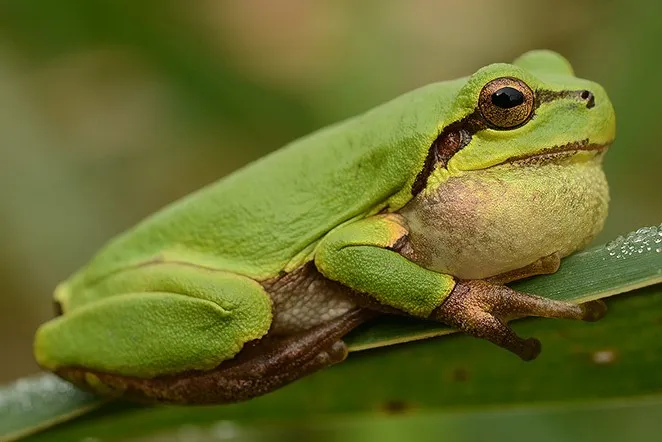

Suweon treefrog
Suweon treefrog
Suweon treefrog
The Suweon treefrog, a rare and endangered amphibian, is found only in South Korea. Let's explore its ecology, unique characteristics, and the critical conservation efforts needed to protect its future.
Suweon treefrog Basic Infomation

| Property | Value |
|---|---|
| Scientific Name | Dryophytes suweonensis |
| Taxonomic Status | accepted |
| Rank | SPECIES |
| Vernacular Names | Suwon Treefrog |
| Kingdom | Animalia |
| Phylum | Chordata |
| Class | Amphibia |
| Order | Anura |
| Family | Hylidae |
| Genus | Dryophytes |

Basic Information
Size: 3~4cm
Weight: 3~6g
Coloration: Green or brown with black spots on the back
Morphology: Long limbs with suction cups on the fingertips
Habitat: Wetlands and rice paddies in South Korea
Diet: Insects, spiders, etc.
Reproduction: Lays eggs in water from spring to summer
Lifespan: Approximately 3 years

A Symbol of South Korea's Natural Heritage: The Suweon Treefrog
In South Korea, amidst landscapes of rice paddies and wetlands,
lives a small frog whose existence holds great significance for the nation's natural heritage.
This is the Suweon treefrog.
A charming amphibian with a green or brown coloration and distinctive black spots.
However, they are now facing the threat of extinction. Why is this happening?
Suweon treefrog Q&A

Why is the Suweon treefrog endangered?
The Suweon treefrog's population is declining due to habitat destruction from urban development and pesticide use, as well as water pollution.
They are listed as Critically Endangered on the IUCN (International Union for Conservation of Nature) Red List.
As an endemic species to South Korea, their existence is globally significant.
We must understand the critical situation of the Suweon treefrog and take action to secure their future.

Where does the Suweon treefrog live?
The Suweon treefrog inhabits wetlands and rice paddies in South Korea.
They prefer areas near water sources and can be found on aquatic plants and rice leaves.
They are nocturnal, becoming active at night to hunt for food.

What kind of sound does the Suweon treefrog make?
The Suweon treefrog's call is a high-pitched "kek-kek-kek" or "kee-kee-kee" sound.
During the breeding season, males call to attract females.
Their calls form a part of the soundscape of the South Korean countryside.

How does the Suweon treefrog reproduce?
The Suweon treefrog breeds in rice paddies and wetlands from spring to summer.
Males attract females by calling from aquatic plants or rocks near the water's edge.
When a female approaches, the male grasps her in a posture called amplexus.
The female lays her eggs in the water, and the male fertilizes them externally.
The eggs hatch in the water, and the tadpoles develop aquatically.

What can we do to protect the future of the Suweon treefrog?
Protecting the future of the Suweon treefrog requires safeguarding their wetland and rice paddy habitats.
We can start by learning about the Suweon treefrog and the environmental issues affecting their habitat.
Then, let's take action to protect these habitats. For example, we can advocate for reduced pesticide use, prevent water pollution, and participate in habitat conservation activities.
Every small action we take can contribute to protecting the future of the Suweon treefrog.

Would you like to become a part of the 'Animalbook.jp'?
Turn your knowledge into Q&A and share it with the world. ※Publication will be activated after purchase. Let's share information together!
Suweon treefrog Type of List

- Suweon treefrog
Information
Congratulations! You are the first commenter!

Create Your Favorite List!
Suweon treefrog
Save the animals you love! Build your own list to quickly revisit your favorites later.

Would you like to leave a comment?
※Please note: This is for the purchase of rights to post comments within the article.
Find Your Favorites!
Our shop offers a unique and attractive selection of goods themed around various animals.
Suweon treefrog References
Suweon treefrog Introduction of media used

Kim, Hyun-tae, CC BY 4.0, via Wikimedia Commons

Help Enrich Our Animalbook.jp with Your Media!
We are constantly looking to expand and enrich our Animalbook.jp with amazing photos and videos of animals. If you have any media that you'd like to share, please contribute and help us showcase the beauty and diversity of the animal kingdom. Your submissions will be credited and featured in our encyclopedia, reaching a wide audience of animal lovers.


