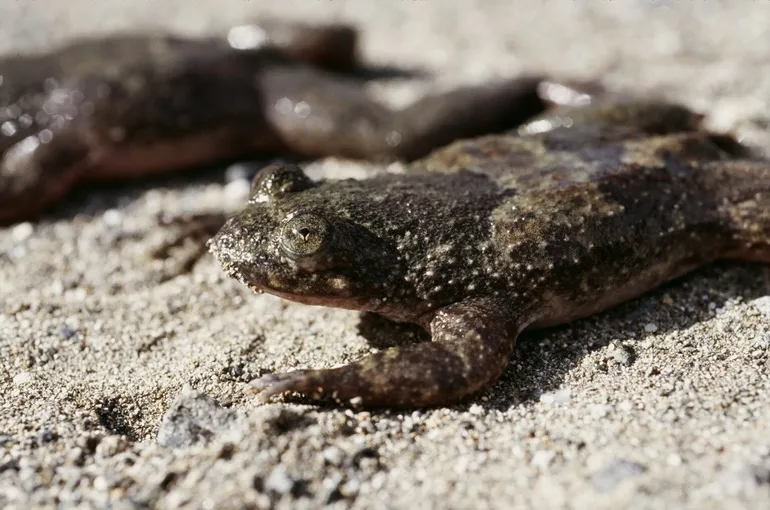

Philippine Flat-headed Frog
In the pristine streams of the Philippines lives an enigmatic frog, the Philippine flat-headed frog. These frogs are unique in the world as they lack lungs. How do they breathe? Let's unravel the mysteries surrounding the Philippine flat-headed frog and their astonishing way of life!
Philippine Flat-headed Frog Basic Infomation

| Property | Value |
|---|---|
| Scientific Name | Barbourula busuangensis |
| Taxonomic Status | SPECIES |
| Rank | Species |
| Vernacular Names | Philippine flat-headed frog, Busuanga jungle toad |
| Kingdom | Animalia |
| Phylum | Chordata |
| Class | Amphibia |
| Order | Anura |
| Family | Bombinatoridae |
| Genus | Barbourula |

The Philippine flat-headed frog ( *Barbourula busuangensis* ) is a frog species belonging to the genus Barbourula in the family Bombinatoridae, found on the islands of Busuanga and Palawan in the Philippines.
They are about 6-8 cm long, with a flattened body and a small head.
Their back is dark brown or black, and their belly is gray or yellow.
Philippine Flat-headed Frog Q&A

What kind of frog is the Philippine flat-headed frog?
The Philippine flat-headed frog is known as the only lungless frog in the world.
They absorb oxygen solely through their skin.
Their skin is so thin that blood vessels can be seen through it.
Their flattened body shape is an adaptation for living in water, reducing resistance to water currents.

Why does the Philippine flat-headed frog lack lungs?
The reason why the Philippine flat-headed frog lacks lungs is not yet fully understood.
However, the streams they inhabit have cold water with high oxygen content, suggesting they can obtain sufficient oxygen through cutaneous respiration alone.
The absence of lungs also makes their bodies lighter, which is advantageous for movement in water.

What does the Philippine flat-headed frog eat?
The Philippine flat-headed frog is carnivorous, feeding on aquatic insects, crustaceans, and small fish.
They are nocturnal, becoming active at night to hunt for food.

How does the Philippine flat-headed frog reproduce?
The reproductive behavior of the Philippine flat-headed frog is not well understood.
However, it is thought that they lay their eggs in water, similar to other Bombinatoridae frogs.
The eggs are covered with a jelly-like substance and are attached to aquatic plants or rocks.

Is the Philippine flat-headed frog endangered?
The Philippine flat-headed frog is facing a decline in population due to habitat loss, pollution, and over-collection for the pet trade, and is listed as Vulnerable (VU) on the IUCN Red List.
Deforestation due to development is shrinking their habitat in the Philippines, and water pollution is also a serious problem.
Protecting their habitat is crucial for the conservation of Philippine flat-headed frogs.

Would you like to become a part of the 'Animalbook.jp'?
Turn your knowledge into Q&A and share it with the world. ※Publication will be activated after purchase. Let's share information together!
Philippine Flat-headed Frog Type of List

- Philippine Flat-headed Frog
Information
Congratulations! You are the first commenter!

Create Your Favorite List!
Philippine Flat-headed Frog
Save the animals you love! Build your own list to quickly revisit your favorites later.

Would you like to leave a comment?
※Please note: This is for the purchase of rights to post comments within the article.
Find Your Favorites!
Our shop offers a unique and attractive selection of goods themed around various animals.
Philippine Flat-headed Frog References
Philippine Flat-headed Frog Introduction of media used

Pierre Fidenci, CC BY-SA 2.5, via Wikimedia Commons

Pierre Fidenci, CC BY-SA 2.5, via Wikimedia Commons

Pierre Fidenci, CC BY-SA 2.5, via Wikimedia Commons

Arvin Diesmos, National Museum of the Philippines, nationalmuseum.gov.ph, Public domain, via Wikimedia Commons

Help Enrich Our Animalbook.jp with Your Media!
We are constantly looking to expand and enrich our Animalbook.jp with amazing photos and videos of animals. If you have any media that you'd like to share, please contribute and help us showcase the beauty and diversity of the animal kingdom. Your submissions will be credited and featured in our encyclopedia, reaching a wide audience of animal lovers.


